That First Step Out of Bed Shouldn't Hurt: Plantar Fasciitis Singapore
Jul 23, 2026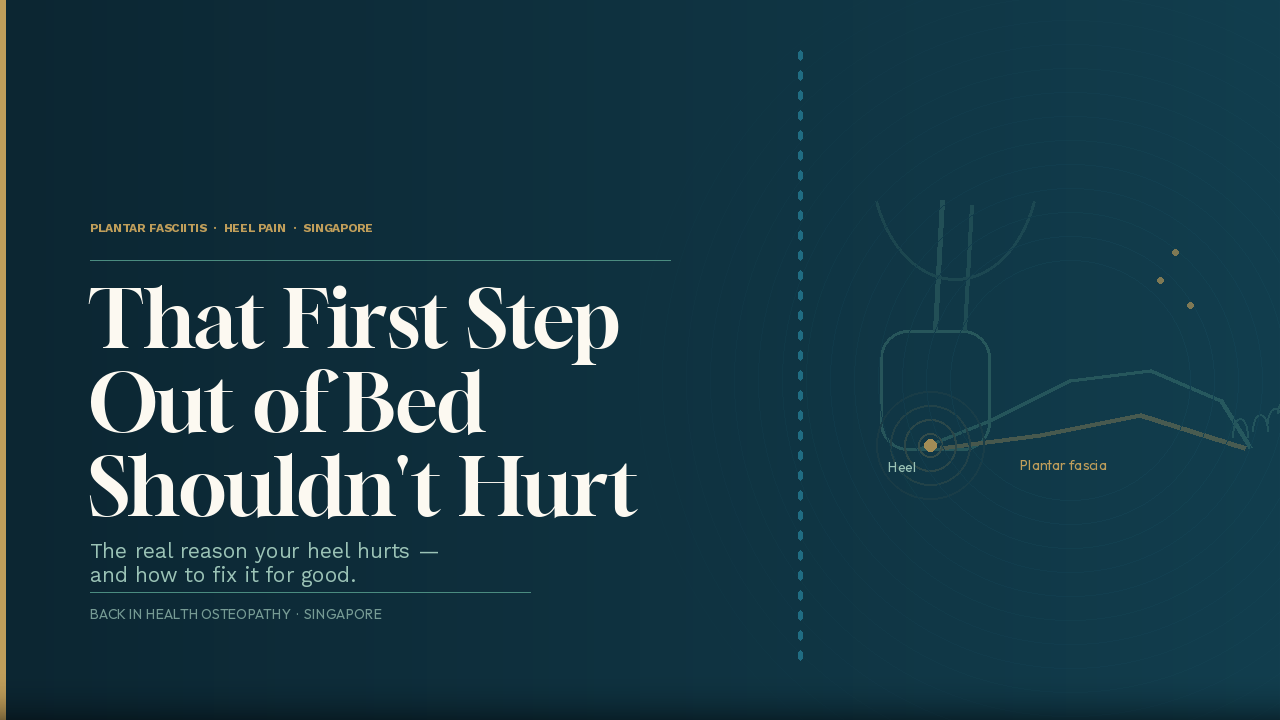
You wake up. It's 6:30am. You swing your legs off the bed, feet touch the floor — and then comes that sharp, stabbing pain through your heel that makes you wince before the day has even started.
You've learned to hobble to the bathroom. After a few minutes of walking it eases off. You start to think maybe it's getting better. Then you sit at your desk for three hours, stand up to get lunch, and it's back.
This is plantar fasciitis. And if you're reading this in Singapore, you're in good company — it's one of the most common musculoskeletal complaints we treat at Back in Health Osteopathy, and it's one of the most misunderstood.
The good news: it responds extremely well to the right treatment. The frustrating news: most people spend months doing the wrong things before they find it.
This article will tell you exactly what's happening in your heel, why it's almost never just a foot problem, and how a combination of osteopathic treatment and shockwave therapy can resolve it — often when everything else has failed.
What Is Plantar Fasciitis?
The plantar fascia is a thick band of connective tissue that runs along the sole of your foot, from your heel bone (calcaneus) to the base of your toes. Its job is to act as a shock absorber and support the arch of your foot during every step you take. It stretches and recoils with every stride, absorbing and releasing force thousands of times a day.
When this tissue is repeatedly overloaded — through excessive standing, running, sudden increases in activity, or prolonged tightness in the structures above it — the insertion point at the heel becomes irritated and inflamed. Over time, this irritation leads to micro-tears in the fascial tissue and a degenerative process that clinicians now often prefer to call plantar fasciopathy — reflecting the fact that it's less about active inflammation and more about failed tissue healing.
Plantar fasciitis affects approximately 10% of the general population at some stage in their lifetime,making it one of the most prevalent musculoskeletal conditions worldwide. In Singapore, it is particularly common among:
- Office workers who spend long hours sitting and then suddenly become active on weekends
- Runners increasing their mileage too quickly ahead of a race
- Healthcare workers, teachers, and retail staff who stand on hard floors for extended periods
- People who have recently changed footwear or started working from home with less structured shoes
- Anyone with naturally tight calves or reduced ankle mobility
The hallmark symptom is heel pain that is worst with the first steps of the morning or after prolonged rest. This is because overnight, the plantar fascia shortens and tightens — and those first weight-bearing steps forcefully stretch a tissue that has been in a contracted position for hours.
The Classic Symptoms — And a Few That Surprise People
Plantar fasciitis has a fairly distinctive symptom pattern once you know what to look for:
First-step pain. That sharp, stabbing heel pain when you first stand up after sleeping or after sitting for a prolonged period is the defining symptom. It typically eases after a few minutes of walking as the tissue warms up and stretches.
Pain that returns after activity. Many people notice the pain settles during a run or walk, only to flare badly in the hour or two afterwards. This "warm-up then worsen" pattern is very typical of plantar fasciopathy.
Heel tenderness on palpation. If you press firmly on the inner front part of your heel — the medial calcaneal tubercle, where the plantar fascia inserts — it will usually be acutely tender. This is one of the most reliable clinical signs.
Arch tightness. Some patients feel a pulling sensation or tightness along the arch of the foot, particularly when stretching the toes back towards the shin.
Stiffness after sitting. Standing up stiffly after a long meeting, a flight, or a long drive and needing a minute to "walk it off" before the foot feels normal again.
What plantar fasciitis typically doesn't involve: significant swelling visible from the outside, pain in the toes, or intense pain during the middle of a run (though it can be bad afterwards). If you have those symptoms, something else may be going on and a proper assessment is worthwhile.
Why It's Almost Never Just a Foot Problem
Here is the part that most heel pain articles miss entirely — and it's the reason so many people spend months treating the foot and getting nowhere.
The plantar fascia doesn't work in isolation. It is the bottom end of a continuous chain of connective tissue that runs up the back of your leg through the Achilles tendon, the calf muscles, the hamstrings, and all the way up through the thoracolumbar fascia in your back. When any part of that chain is tight, restricted, or dysfunctional, the plantar fascia absorbs the excess load.
A key clinical finding in plantar fasciitis assessment is limited ankle dorsiflexion — the ability to flex your foot upward — which is a strong indicator of calf muscle and Achilles tendon tightness that directly contributes to increased plantar fascia loading. In our clinic, restricted ankle dorsiflexion is present in the vast majority of plantar fasciitis patients we see.
The most common upstream contributors we find at Back in Health include:
Tight calves and Achilles tendon. The gastrocnemius and soleus muscles insert into the heel via the Achilles tendon. When these are chronically tight — which they almost always are in desk-bound workers and recreational runners — every step requires the plantar fascia to compensate for what the ankle can't do. The result is excessive tensile load at the heel insertion, day after day, until the tissue breaks down.
Restricted ankle joint mobility. Beyond muscle tightness, the ankle joint itself can have restricted movement from old sprains, stiffness, or poor mobility. A joint that doesn't glide freely changes how force is distributed through the entire foot on every footfall.
Hip and gluteal weakness. This surprises most patients, but hip abductor and gluteal weakness changes how the leg loads through the foot. When the hip doesn't stabilise well, the foot often collapses inward (pronates excessively), increasing the tensile stress on the plantar fascia's medial band. This is particularly relevant for runners.
Lumbar and sacral restrictions. The nerve supply to the foot travels from the lower back, through the sacrum, and down the leg. Restrictions in the lumbar spine or sacroiliac joint can sensitise the nerves supplying the heel, making the plantar fascia more reactive and slower to heal. In some patients, what looks like classic plantar fasciitis has a significant neural component that won't resolve without addressing the lower back.
Footwear changes. Singapore's transition to working from home introduced a specific pattern we began seeing frequently — people who spent years in structured corporate shoes suddenly spending all day in flat slippers or barefoot on hard marble floors. The change in heel height and support dramatically increases plantar fascia loading, and the tissue takes time to adapt.
An osteopathic assessment looks at all of these factors. Treating only the heel while leaving the calf, ankle, hip, and lower back unaddressed is the reason so many plantar fasciitis cases drag on for months or years.
How Osteopathy Treats Plantar Fasciitis
At Back in Health Osteopathy Singapore, we take a whole-chain approach to plantar fasciitis. Treatment works from the ground up and the top down simultaneously.
Calf and Achilles soft tissue release. Reducing tension in the gastrocnemius, soleus, and Achilles complex is one of the highest-yield interventions for plantar fasciitis. Manual soft tissue work, myofascial release, and targeted trigger point treatment in the calf significantly reduce the load being transmitted to the heel. Many patients notice an immediate reduction in heel pain following this work — not because we've touched the heel at all, but because we've addressed what was pulling on it.
Ankle joint mobilisation. Restoring full, free movement to the ankle joint improves dorsiflexion and changes the mechanics of every step. When the ankle can flex fully, the calf and plantar fascia no longer need to compensate. This is a frequently overlooked but highly effective component of plantar fasciitis treatment.
Plantar fascia and intrinsic foot muscle work. Direct work to the sole of the foot — massage, myofascial release, and mobilisation of the foot joints — reduces local tension and improves the tissue environment for healing.
Lumbar and sacroiliac assessment and treatment. Where lower back or pelvic restrictions are contributing to nerve sensitisation or altered loading patterns, we address these as part of the treatment. Resolving spinal restrictions often accelerates the response of stubborn plantar fasciitis cases that haven't responded to local treatment alone.
Hip and gluteal strengthening prescription. Where hip weakness is contributing to excessive pronation and medial fascial load, we prescribe targeted exercises to build the proximal stability that protects the foot.
Dry needling. For cases with significant trigger point activity in the calf, tibialis posterior, or the intrinsic muscles of the foot, dry needling can produce rapid reductions in tension and pain. It is particularly useful for patients who have chronic, treatment-resistant tightness in the posterior chain.
Shockwave Therapy: The Game-Changer for Stubborn Cases
For patients whose plantar fasciitis has been present for three months or more — or for those who have tried stretching, orthotics, and rest without lasting improvement — shockwave therapy is often the intervention that finally turns the corner.
Back in Health offers shockwave therapy as part of our treatment toolkit, and for chronic plantar fasciitis, the evidence supporting it is compelling.
A 2024 systematic review and meta-analysis found that shockwave therapy was more effective than corticosteroid injections in reducing pain, decreasing plantar fascia thickness, and improving foot function at both three and six months post-treatment. This is a significant finding — corticosteroid injections have long been the default "next step" for plantar fasciitis that doesn't respond to conservative care, yet the evidence now shows shockwave therapy outperforms them without the tissue-weakening risks that repeated steroid injections carry.
Studies have shown significant reductions in pain scores from a baseline of 7.7 down to 1.8 at six months following shockwave treatment for plantar fasciitis.
Shockwave therapy has been found to be both effective and well-tolerated for plantar fasciitis, with specific treatment parameters influencing outcomes in pain relief.
How does it work? Shockwave therapy delivers focused acoustic energy into the affected tissue, stimulating blood flow, breaking down calcific deposits, disrupting pain signalling, and triggering the body's own healing cascade in tissue that has otherwise become stuck in a chronic, non-healing state. For plantar fasciopathy — where the primary problem is failed tissue healing rather than active inflammation — this mechanical stimulation is often exactly what the tissue needs to reset and begin genuine repair.
At Back in Health, shockwave therapy is typically delivered as a short series of sessions (usually three to five), often combined with manual therapy and exercise prescription for the best outcomes.
What You Can Do Right Now
While you're waiting for an appointment, or if your symptoms are mild and you're looking to start managing the problem at home:
The towel stretch — before your first step. Before you get out of bed in the morning, loop a towel or resistance band around the ball of your foot and gently pull your toes back towards your shin. Hold for 30 seconds, three times. This pre-stretches the plantar fascia before weight-bearing and significantly reduces first-step pain for most people. Do it every morning without exception.
Calf stretches — twice daily, every day. Stand facing a wall, place your hands on the wall for support, step one foot back, and lean forward until you feel a deep stretch through the calf. Hold for 45 seconds. Do this with the knee straight (targeting gastrocnemius) and with the knee slightly bent (targeting soleus). Both heads of the calf contribute to plantar fascia loading. This is the single most evidence-supported self-care intervention for plantar fasciitis.
Frozen water bottle rolling. Fill a standard water bottle, freeze it, and roll it under your foot for 5–10 minutes after activity. The combination of massage and cold reduces local pain and inflammation and is something virtually every plantar fasciitis patient we see finds helpful.
Review your footwear immediately. If you're spending significant time in flat, unsupportive shoes, slippers, or barefoot on hard floors, change this today. You don't need custom orthotics right away — a shoe with a modest heel lift and good arch support can make a meaningful difference while you're getting treatment. Avoid being barefoot on hard surfaces entirely until symptoms settle.
Reduce your standing and walking load temporarily. If your job requires prolonged standing, see if you can use a cushioned anti-fatigue mat. If you're a runner, reduce your mileage by 30–40% and avoid running on hard surfaces or hills until you've had a proper assessment.
Don't try to stretch through the pain. Aggressively stretching an irritated plantar fascia — particularly any stretching that causes heel pain — can worsen the condition. Stretching should feel like a gentle pull through the calf and arch, not pain at the heel.
How Long Does Plantar Fasciitis Take to Heal?
This is the question everyone wants answered. The honest answer: it depends significantly on how long it's been present and how it's managed.
Acute cases caught within the first six to eight weeks and treated appropriately can resolve in four to eight weeks. Cases that have been present for three to six months typically take eight to twelve weeks of consistent treatment and rehabilitation to resolve fully. Chronic cases that have been mismanaged or ignored for over a year can take longer still — but even these respond well to shockwave therapy combined with manual therapy, often achieving meaningful improvement within six to ten sessions.
The worst outcomes we see are in patients who alternate between rest (which provides temporary relief) and returning to full activity too quickly (which re-irritates the tissue). The key is consistent, progressive loading — restoring the plantar fascia's capacity to handle load gradually, not simply waiting for the pain to disappear.
When Should You See an Osteopath?
We recommend getting an assessment at Back in Health if:
- Heel pain on your first steps in the morning has been present for more than two weeks
- You've been stretching and resting but the pain keeps returning
- Your heel pain is affecting your ability to exercise, work, or enjoy daily activities
- You've had a cortisone injection and the relief didn't last
- You've been told you have a heel spur — this is almost always a secondary finding and doesn't change the treatment approach, but it does warrant a full assessment
- You're a runner who wants to continue training and needs a structured management plan
Start Your Mornings Differently
Plantar fasciitis doesn't have to be the thing that defines your mornings. That sharp first step, the wince before the day begins, the gradual dread of getting out of bed — these are not things you simply have to live with.
At Back in Health Osteopathy Singapore, we treat plantar fasciitis regularly and successfully. Our approach — combining osteopathic manual therapy, targeted rehabilitation, and shockwave therapy where indicated — addresses both the foot and the full chain of contributing factors. Not just the symptom, but the reason it developed in the first place.
📍 Book your assessment today at www.backinhealth.com.sg/bookings
Your first step tomorrow morning should be pain-free. Let us help make that happen.